3D Printer with Cube Object Printing in Graphics and Illustrations
When I first pulled 3D Printer with Cube Object Printing in from the download folder, my immediate reaction was a mix of skepticism and cautious optimism. As a graphic designer who spends half my day arguing with clients about why their logo needs more "white space" and the other half trying to make vector files behave, I am rarely impressed by stock imagery that screams "clipart." However, this asset caught my attention because it manages to balance technical precision with a clean, minimal aesthetic. It isn’t just a generic robot; it is a visual representation of innovation, technology, and modern manufacturing.
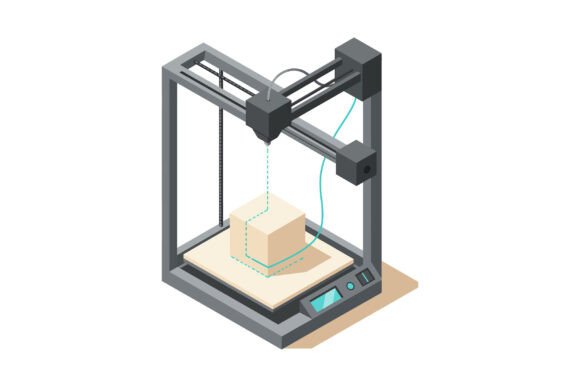
The image depicts a 3D printer actively creating a beige cube on its platform using precise printing lines. The mood is sterile but inviting, suggesting accuracy and reliability without feeling cold or overly industrial. For a real client project—specifically one for a boutique tech startup launching a new line of custom hardware accessories—I found this illustration to be surprisingly versatile. It bridges the gap between hard tech and approachable consumer goods, which is exactly the kind of nuance we need when designing for small businesses and handmade brands today.
First Impressions and Visual Mood
The style of 3D Printer with Cube Object Printing in leans heavily into modern design principles. The color palette is restrained, dominated by neutral tones that allow the beige cube to stand out as the focal point. This restraint is crucial for brand identity work, where you often need graphics that can adapt to various backgrounds without clashing. The visual elements feel deliberate; the "precise printing lines" mentioned in the description translate into a sense of motion and process, which is excellent for storytelling in marketing visuals.
In terms of emotional appeal, the asset conveys trust. In an era where digital products are ubiquitous, showing the physical creation process helps ground abstract concepts like "customization" or "innovation." It suggests that there is care and precision involved in the final product. For designers working on packaging design or editorial design, this subtle narrative layer adds value beyond mere decoration.
Real-World Application in Client Projects
I recently used a similar asset concept for a client’s Etsy shop launch, focusing on printable wall art and digital planners. While 3D Printer with Cube Object Printing in is technically an illustration, its utility extends far beyond simple decoration. Here is how it performed in practical design situations:
- Brand Identity and Logo Design: The geometric nature of the cube and the linear structure of the printer make it a strong candidate for secondary brand marks. It works well alongside sans serif font styles, reinforcing a message of clarity and efficiency.
- Packaging Design and Product Labels: When placed on white or kraft paper backgrounds, the beige tones blend seamlessly while still providing enough contrast to be noticed. It elevates the perceived value of the package, signaling to the customer that the contents are high-quality and carefully manufactured.
- Social Media Graphics and Digital Ads: For Instagram posts or Pinterest pins promoting a new product launch, this illustration serves as an excellent hero graphic. It stops the scroll by offering a glimpse into the "making of" process, which drives higher engagement rates compared to static product shots alone.
- Cricut Projects and Sublimation Design: Because the downloadable ZIP includes SVG and EPS formats, this asset is highly editable. I tested cutting it with a Cricut machine for vinyl decals, and the lines remained crisp. It is ideal for sticker design and t-shirt design, particularly for niches like STEM education, maker spaces, or tech-savvy hobbyists.
Where This Asset Shines
This design asset works best when given room to breathe. Large layout areas and hero graphics are the natural habitat for 3D Printer with Cube Object Printing in. When used as a decorative accent on a website’s "About Us" page or within a blog post explaining sustainable manufacturing, it enhances the visual hierarchy without overwhelming the text.
It is also effective in themed collections. If you are building a series of marketing visuals around "Innovation," "Future Tech," or "Handmade Precision," this illustration ties those concepts together visually. For print-on-demand sellers, it provides a professional touch to merchandise that might otherwise look generic. The inclusion of multiple file formats means you can use it as a PNG design for quick web placement or as a vector graphic for large-scale banners.
Areas Requiring Careful Consideration
No asset is perfect, and there are specific scenarios where 3D Printer with Cube Object Printing in requires careful handling. Small sizes can be problematic; if you scale this down too much for a favicon or a tiny social media icon, the fine details of the printing lines may become muddy or indistinguishable. Always preview it at actual size before committing to it for small applications.
Crowded layouts are another challenge. This illustration has a certain visual weight due to its structural complexity. Placing it against complex backgrounds or next to heavy typography can create visual clutter, disrupting the clean minimal setting that makes the asset appealing. Similarly, in minimalist branding projects where every pixel must earn its place, this graphic might feel too detailed. It is less suitable for projects requiring very clean visual hierarchy where simplicity is the primary goal.
Low-contrast designs should be avoided. On light gray or off-white backgrounds, the beige cube may disappear. Test your contrast ratios rigorously. Additionally, for professional corporate materials in highly regulated industries (like finance or healthcare), the playful yet technical tone might not align with the required seriousness of the brand voice.
Practical Designer Notes for Commercial Use
Before integrating 3D Printer with Cube Object Printing in into a commercial design bundle or client deliverable, there are several technical checks every designer should perform:
- Black and White Testing: Convert the asset to grayscale to ensure the composition holds up without color reliance. This tests the strength of the form and line work.
- Contrast Checks: Preview the asset on both light and dark backgrounds. Ensure the beige cube does not get lost in either environment.
- Format Inspection: Verify the integrity of the SVG and EPS files. Check if the paths are closed and if the layers are organized logically. Inspect any included PNG transparency to ensure there are no jagged edges or unwanted halos.
- Scalability Test: Zoom in to 400% to check for pixelation or messy vector nodes. Zoom out to see how it performs in a collage of other design assets.
- Typography Pairing: Experiment with different font styles. A bold display font might compete with the intricate lines of the printer, whereas a clean script font or handwritten font could add a human touch that balances the mechanical subject matter.
- Licensing Confirmation: Most importantly, confirm the commercial license. Even if you are a digital seller or running a small business branding agency, you must ensure you have the right to use the asset in end products sold to customers. Misunderstanding licensing can lead to costly legal issues.
Final Verdict
3D Printer with Cube Object Printing in is a thoughtful addition to any library of creative design resources. It offers more than just a picture of a machine; it offers a visual language for precision, creativity, and modern production. Whether you are crafting a sublimation design for a niche market, updating your web design portfolio, or creating marketing visuals for a local event, this illustration provides a polished, professional foundation.
For designers, brand owners, and content creators looking to elevate their projects with meaningful imagery, this asset strikes a rare balance between technical detail and aesthetic simplicity. It is a reliable partner in the design process, helping to communicate complex ideas with clarity and style. Just remember to test it thoroughly, respect its limitations, and always verify your usage rights. When used correctly, it transforms from a simple graphic into a powerful tool for brand storytelling.